How to bend a kick in conduit
How to bend · Published November 8, 2026
Mark for a 4″ kick at 22-1/2°
10-3/8″
Measure it from the end that has to stand off, on a Klein 56203, 1/2 inch EMT. It goes under the arrow.
Bender values: Klein Tools Conduit Bender Guide (56203–56207, 56211), page 6.
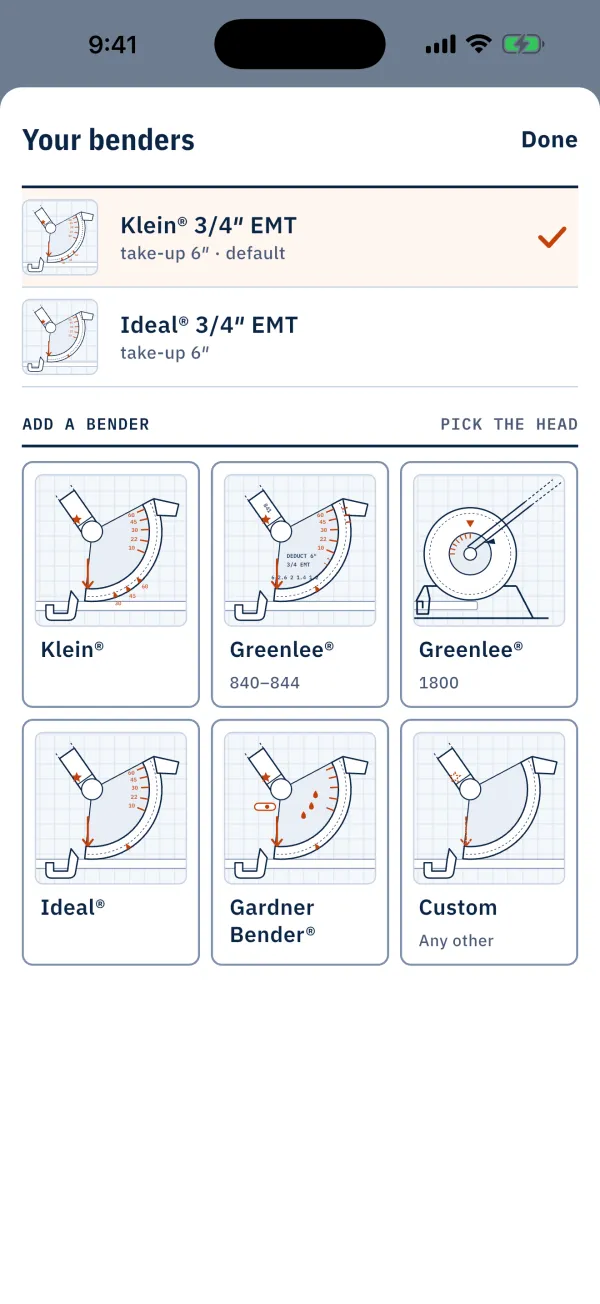
Your own marks
Bendbook draws every mark for the bender in your hand, numbered in bending order. Offline.
A kick is a single bend that steps the end of a conduit away from a wall, a box or a surface it has to clear. To place it, multiply the depth you need by your bender's multiplier for the bend angle. Measure that far from the end and mark it. Put the mark under the arrow and bend.
How the depth sets the mark
The kicked leg runs at an angle, and the multiplier is how much slanted stick it takes for each inch of depth. At 22-1/2° on a Klein 56203 with 1/2 inch EMT the multiplier is 2.6. So the mark from the end is the depth × 2.6.
Here is a 4 inch kick at 22-1/2° on that bender:
- Offset depth
- 4″
- Bend angle
- 22-1/2°
| Mark | From the end | Line up with | Bend | Direction |
|---|---|---|---|---|
| 1 | 10-3/8″ | Arrow | 22-1/2° | First bend |
- Multiplier
- 2.6
- Shrink per inch of depth
- 3/16″
- Distance between bends
- 10-3/8″
- Shrink
- 3/4″
Bender values: Klein Tools Conduit Bender Guide (56203–56207, 56211), page 6.
Calculate this bend in Bendbook. Pick your bender, type your measurements, and every mark is drawn on the stick for you.
The end you measured from is the end that ends up 4 inches off the line of the rest of the stick. A deeper kick moves the mark further from the end. A steeper angle moves it closer, because a steeper bend reaches the depth in less stick. The multiplier at 30° is smaller than at 22-1/2°, so the mark comes in. For 30° work, see the offset multiplier for 30 degrees.
Check the multiplier against the bender in your hand. Other makes and sizes print their own.
Shrink on a kick
The kicked leg covers less straight run than its length along the stick. That difference is the shrink: 3/16″ for each inch of depth at 22-1/2° on this bender. The example's table shows the total for this kick.
Shrink does not move the mark when you measure from the end that kicks out. It makes the stick reach less far along the run, so it matters when you cut a stick that has to land on a fixed point past the kick.
Steps
- Decide which end of the stick has to stand off the wall. You measure from that end.
- Pick the depth of the kick and the bend angle.
- Multiply the depth by the multiplier for that angle. At 22-1/2° on a Klein 56203 it is 2.6. That is your mark distance.
- Measure the mark distance from the end and mark the stick. Carry the line around so you can see it from above.
- Set the bender on the stick with the mark under the arrow.
- Check which way the kick will point before you pull. The end you measured from has to come up off the line of the run.
- Bend until the stick reaches the angle on the head. For this kick that is 22-1/2°.
- Hold the stick in place and check that the end clears the wall by the depth you wanted.
Mistakes that cost a stick
- Measuring from the wrong end. The mark is a distance from the end that kicks out. Measure from the other end and the kick lands in the wrong place.
- Using the wrong multiplier. Each angle has its own. Use the one for the angle you bend, on your own bender.
- Lining up with the wrong head mark. Use the arrow for a kick. The degree lines only show how far the bend has gone.
- Over-bending. Past the angle you chose, the depth grows and the conduit no longer fits. Stop at the angle line and check.
- Bending the wrong way. A lone kick that points the wrong way is not scrap: roll the stick 180° and it points the other way. It is scrap when the kick has to line up with a bend already on the stick.
- Forgetting shrink when you cut. The stick reaches less far after the bend. Leave room for it.
Questions
Is a kick the same as an offset?
No. An offset is two bends that bring the conduit back to a line parallel to where it started. A kick is one bend that leaves the conduit running at an angle. If you need the conduit to run straight again, you want an offset.
Do I need to roll the conduit for a kick?
Not to make the bend. A kick is a single bend, so there is nothing to roll between bends. Keep the stick seated the same way from the mark to the finish. Rolling it 180° only makes the kick point the other way.
What if I need to turn the conduit as well as kick it?
That is a different bend. A 90 degree stub-up turns the conduit, and saddles cross an obstacle with a three-point saddle or a four-point saddle. Browse all of them in the guides index.
Which angle should I use for a kick?
Use an angle your bender prints a multiplier for, and one the job allows. Shallow angles give a gentler bend and a longer slanted leg. Steeper angles step the conduit over sooner but need more room for the bend itself.
Check against your own bender. The numbers on this page use the values the maker publishes for the bender named; where the maker prints none, they are worked out from the geometry of the bend. Shoes wear, conduit varies and springback differs, so make one test bend and adjust before you bend the run.