How to bend a box offset on 3/4 inch EMT
How to bend · Published November 8, 2026
Distance between bends
3″
A 1/2 inch box offset at 10° on a Klein 56204, 3/4 inch EMT. Both marks go on the arrow.
Bender values: Klein Tools Conduit Bender Guide (56203–56207, 56211), page 6.
Your own marks
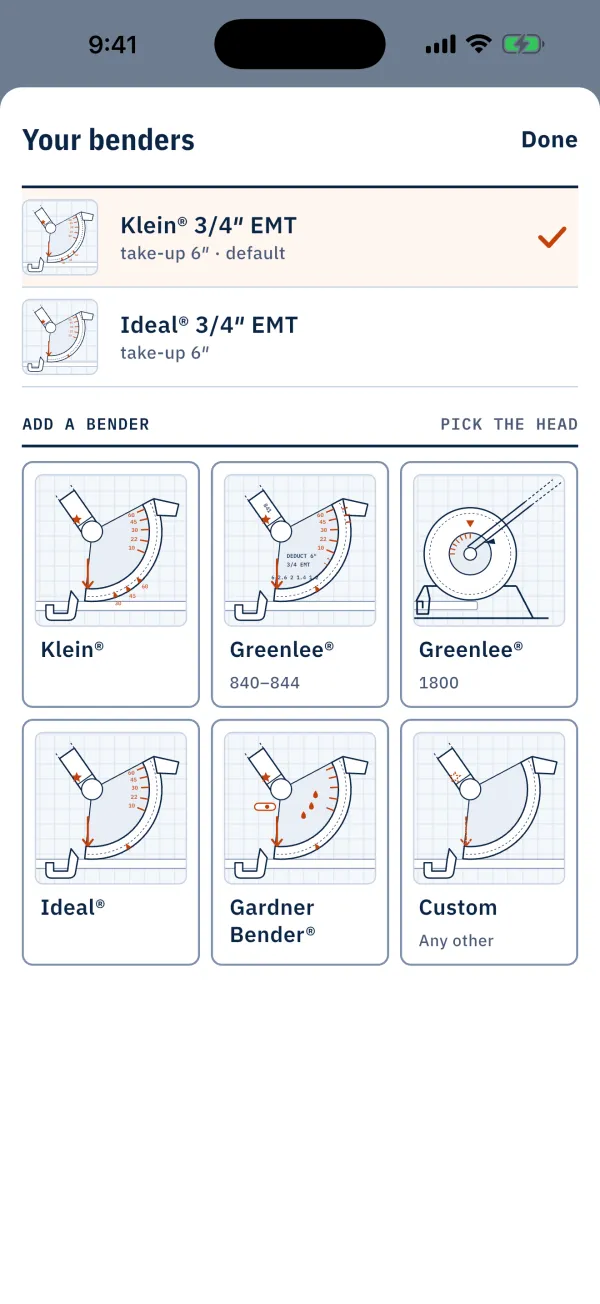
Bendbook draws every mark for the bender in your hand, numbered in bending order. Offline.
A box offset is a shallow offset at the end of a stick. It steps the end out from the wall so it goes straight into the box, while the run stays flat on the wall. The step is small, so it is bent at a low angle, 10° here. Multiply the depth by the 10° multiplier to get the distance between the marks, bend at the arrow, roll the stick half a turn, and bend again.
The worked example
This is a box offset in 3/4 inch EMT on a Klein 56204, 0.5 inch deep at 10°. Measure your own box to find the depth you need.
- Offset depth
- 1/2″
- Bend angle
- 10°
| Mark | From the end | Line up with | Bend | Direction |
|---|---|---|---|---|
| 1 | 3″ | Arrow | 10° | First bend |
| 2 | 6″ | Arrow | 10° | Roll the conduit 180° |
- Multiplier
- 6
- Shrink per inch of depth
- 1/16″
- Distance between bends
- 3″
- Shrink
- 1/16″
Bender values: Klein Tools Conduit Bender Guide (56203–56207, 56211), page 6.
Calculate this bend in Bendbook. Pick your bender, type your measurements, and every mark is drawn on the stick for you.
Both marks are measured from the end that goes into the box. The distance between them comes from the multiplier Klein prints for 10°, 6. A low angle spreads even a shallow step over a good length of stick, which keeps the offset gentle.
Steps
- Hold the stick up to the box and measure how far the end has to step out to line up with the knockout. That is your offset depth.
- Make the first mark where the offset should start, measured from the end that goes into the box. Leave enough straight stick at the end to go into the connector.
- Multiply the depth by the 10° multiplier, 6. That is the distance between the marks.
- Make the second mark that far past the first, away from the end.
- Before the first bend, check which way the end has to step out, and set the stick in the bender so the offset kicks that way.
- Line the first mark up with the arrow.
- Bend to 10°. The degree lines only show how far you have gone.
- Take the stick out and roll it exactly half a turn, 180°.
- Slide the stick to the second mark and line it up with the arrow.
- Bend to 10° again.
- Lay the stick on a flat floor. The run should lie flat and the end should sit out by the offset depth. Offer it up to the box before you cut the far end.
Check which way the offset kicks before you make the first bend. A box offset bent the wrong way costs a stick.
Shrink on a box offset
An offset pulls the stick a little shorter: 1/16″ for every inch of depth at 10°.
Here you measure from the end that goes into the box, so shrink does not move your marks. It only makes the run past the offset shorter. On a box offset that is a very small amount. On a tight run from box to box, measure for the far end after you bend, not before. For the full list, see the conduit shrink chart.
Mistakes that cost a stick
- Rolling the wrong amount. Half a turn is the only roll that keeps both bends in one plane. A quarter turn or a casual twist gives a dog leg, and the end will not line up with the knockout.
- Measuring from the wrong end. Both marks come from the end that goes into the box.
- Lining up with a degree line. The mark goes on the arrow. The degree lines only show how far the bend has gone.
- Over-bending. At a low angle, a few degrees too much changes the depth a lot. Stop at 10° and offer the stick up to the box.
- Using another bender's figures. Check the multiplier against the guide for the bender in your hand.
Questions
Why use 10° for a box offset?
The step into a box is shallow, and a low angle gives a gentle offset that sits flat. A steeper angle works too, but it changes the multiplier and brings the bends closer together. See the 10° multiplier guide, the 22-1/2° guide and the 30° guide.
Can I use the same marks on a different bender?
Check first. Makers print their own multipliers and shrink, so work the marks from the guide for your own model. The Klein bender chart lists the published values for Klein benders.
What if I need two or more box offsets side by side?
Offsets in a rack have to be laid out so they line up with each other. Our guide to parallel offsets covers how.
Is a box offset the same as a kick?
No. A kick is a single bend. A box offset is two bends that bring the conduit back to its original direction, stepped out by the offset depth. See how to bend a kick in conduit.
Check against your own bender. The numbers on this page use the values the maker publishes for the bender named; where the maker prints none, they are worked out from the geometry of the bend. Shoes wear, conduit varies and springback differs, so make one test bend and adjust before you bend the run.